
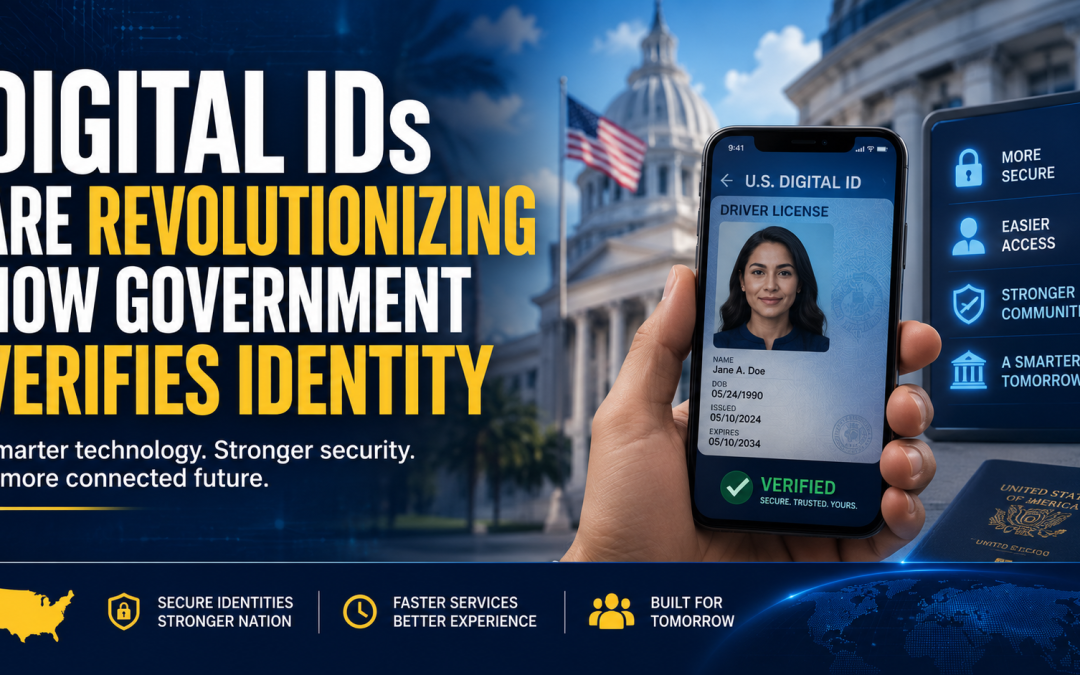
WASHINGTON — The adoption of digital identification and mobile driver’s licenses (mDLs) is reshaping the traditional methods by which the government verifies citizen identity. As these tools integrate into airports, government offices, and private establishments, there is a growing public expectation regarding the responsible handling of personal data.
Until recently, verification involved the presentation of a physical document. Today, that exchange is evolving toward digital credentials stored on smartphones. Government agencies, which previously focused on detecting laminated forgeries, must now adapt their protocols to validate digital identities that vary by state of issuance.
A Fragmented Landscape and the Need for Standardization
In the United States, mobile driver’s licenses are rapidly transitioning from pilot programs to a conventional digital identity infrastructure. Data from October 2025 indicates that 76% of the U.S. population resided in states with active or developing mDL programs. By June 2026, the American Association of Motor Vehicle Administrators (AAMVA) reported that only eight states or territories were not participating in digital identification schemes.
The implementation of REAL ID standards, initiated in May 2025, has heightened the urgency for secure, standards-based credentials. Currently, the Transportation Security Administration (TSA) accepts mDLs at more than 250 priority airports, and adoption is projected to reach tens of millions of users by the end of 2026, driven by expansion in high-population states.
However, deployment faces interoperability challenges. States operate on different platforms, applications, and timelines; some rely on digital wallets like Apple or Google, while others develop proprietary applications. This fragmentation forces federal agencies to potentially manage 50 distinct variations of identity verification.
Experts note that agencies cannot develop 50 separate integrations. The proposed solution is a technological layer that translates state-specific formats into a consistent, standardized verification signal, similar to how payment networks enable merchants to accept cards from various issuing banks.
The ISO/IEC 18013-7 technical standard has emerged as the common language the industry is adopting to unify these processes, enabling the government to build systems around a shared standard rather than managing state-level differences.
Data Minimization and Privacy
Beyond airport verification, the most significant impact of digital identification lies in privacy and data minimization. In the current model, verifying a specific fact (such as age or residency) requires presenting a full document, exposing all personal information.
The reusable identity model allows citizens to answer specific questions (“Am I over 21?”, “Am I a resident?”) without revealing the entire document. This reduces the volume of sensitive data stored in individual systems, enhancing cybersecurity by limiting the exposure of information that is never collected in the first place.
As digital identification adoption increases, so do public expectations regarding data handling. It is anticipated that citizens will question why government agencies require full documents to verify simple facts. Agencies that implement reusable and minimal-disclosure verification will anticipate these privacy demands rather than scrambling to meet them later.
Security Challenges and the Future
As verification methods become more sophisticated, so do the attempts to circumvent them. Experts warn that the cybersecurity arms race observed in the private sector will inevitably reach government systems.
The consensus among program administrators is that future success will depend on building layered, standards-based verification, treating reusable identity as a privacy tool rather than merely a convenience feature, and centrally addressing state-level disparities rather than waiting for fragmentation to resolve itself.